

Key Takeaways
- PCBA (printed circuit board assembly) creates functional circuit boards by soldering components onto bare PCBs.
- Box build integrates PCBAs with additional elements like enclosures and wiring to produce complete products.
- Choosing between PCBA vs box build depends on whether you need a single board or a full assembly for your project.
- NOTE UK offers both PCBA and box build, streamlining the manufacturing process from prototyping to production.
- Understanding IPC Class 3 standards ensures high-quality, reliable electronic assembly for critical applications.
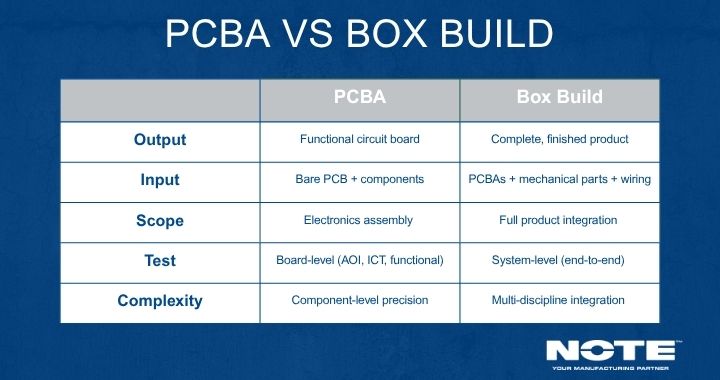
PCBA (printed circuit board assembly) and box build are two distinct stages of electronics manufacturing. PCBA produces a functional circuit board by mounting and soldering electronic components onto a bare PCB. Box build takes that PCBA and integrates it with mechanical enclosures, wiring, connectors and other sub-assemblies to produce a complete, finished product ready for end use.
What is PCBA?
PCBA stands for printed circuit board assembly – the process of populating a bare printed circuit board (PCB) with electronic components and soldering them in place to create a working circuit.
The process typically involves:
- Surface mount technology (SMT): components are placed and soldered directly onto the surface of the board using automated pick-and-place machines. SMT handles the majority of modern electronic components and enables high-density, high-speed assembly.
- Through-hole assembly: leads of larger components – connectors, capacitors, some transformers – are inserted through holes in the board and soldered from the underside. Many boards require a combination of SMT and through-hole processes.
- Inspection and test: completed PCBAs are inspected using automated optical inspection (AOI), X-ray (for BGA components) and in-circuit or functional testing to verify the assembly meets specification before it moves downstream.
The output of PCBA is a tested, functional circuit board – but not yet a finished product the end user can use.
What is box build?
Box build (also called systems integration or full product assembly) is the next stage: taking one or more PCBAs and assembling them with all the other elements needed to create a complete, usable product.
A box build typically involves:
- Mechanical assembly: mounting PCBAs into an enclosure or chassis
- Cable and harness assembly: connecting boards to displays, sensors, power supplies and I/O
- Sub-assembly integration: combining PCBAs with fans, batteries, screens, keypads or custom mechanical parts
- Final system test: verifying the complete assembly functions correctly end-to-end
Which do you need?
PCBA only
Appropriate when your product contains a single board that you or another party will integrate into a larger system, or when you handle final assembly in-house. It is also the right starting point for new product introduction (NPI) – validating the electronics before committing to full box build tooling.
Box build only
Applies if you supply your own PCBAs and need a partner to handle mechanical integration and final assembly.
Both together
– A full turnkey engagement – is the most common model for original equipment manufacturers (OEMs) who want a single EMS partner to manage the complete manufacturing process from bare board to finished product. Turnkey gives you one point of accountability, simplified logistics and a cleaner quality chain.
The right answer also depends on volume. At prototype and low-volume NPI stages, PCBA and box build are often treated as separate, iterative processes. At volume production, combining them under one roof typically reduces lead time, cost and the risk of inter-process quality escapes.
How NOTE UK approaches PCBA and box build
NOTE UK offers both PCBA and box build across our six UK sites, allowing customers to consolidate the full manufacturing process – from prototyping through to volume serial production – with a single partner.
Our PCBA capability covers SMT and through-hole assembly, AOI, X-ray inspection and functional test, certified to IPC Class 2 and Class 3 (including for defence and mission-critical applications). Box build ranges from simple sub-assemblies to complex, fully integrated systems.
Talk to the NOTE UK team about your project →info.note@note-ems.co.uk
Frequently asked questions
What does PCBA stand for?
PCBA stands for printed circuit board assembly – the process of mounting electronic components onto a bare PCB and soldering them in place to create a functional circuit.
What is box build in electronics manufacturing?
Box build is the assembly of a complete electronic product, integrating one or more PCBAs with an enclosure, wiring, connectors and other components to produce a finished, testable unit.
Is box build the same as system integration?
Yes — box build and system integration are used interchangeably in the EMS industry. Both refer to the process of integrating PCBAs and sub-assemblies into a complete product.
What is a turnkey electronics manufacturing service?
A turnkey service means the EMS provider manages the entire process – component sourcing, PCBA, box build and test – delivering a finished product. The customer supplies the design; the EMS provider handles everything else.
What is IPC Class 3 in electronics assembly?
IPC Class 3 is the highest workmanship standard in electronics assembly, required for products where failure is not acceptable – such as medical devices, defence systems and aerospace electronics. It specifies tighter tolerances for solder joints, inspection and documentation than Class 2 (commercial/industrial).
What is the difference between SMT and through-hole assembly?
SMT (surface mount technology) mounts components directly onto the surface of the PCB; through-hole assembly inserts component leads through holes in the board and solders them on the underside. Most modern boards use both processes.
*Published by NOTE UK. Explore our Manufacturing and Prototyping capabilities, or contact the team to discuss your project.